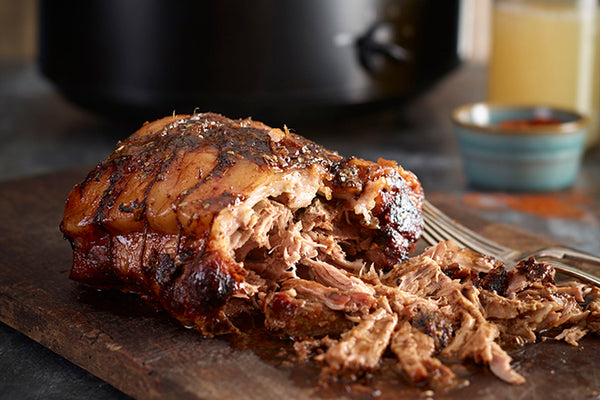
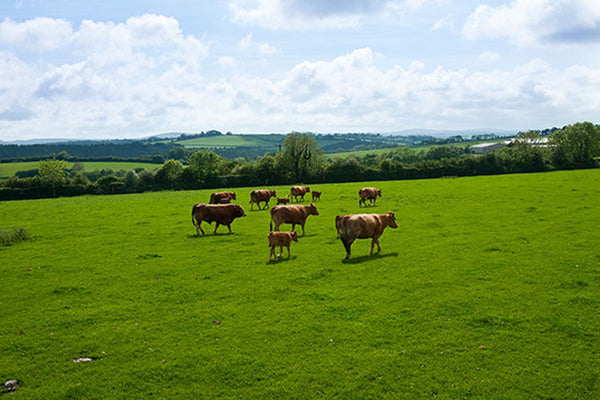
Our friends at Love Pork from are launching a new ad campaign next week, designed to encourage a new range of ‘One Pot’ pulled pork recipes. With a focus on the ease and affordability of pork shoulder, the campaign will carry on the good work of the previous ‘Make it Pulled Pork’ campaign in April.
The new campaign will highlight how healthy and versatile pork can be, especially as a midweek-meal. At ĢƵ we couldn’t agree more. With more people working from home again, tasty pulled pork is a great option for time-poor families on a budget to enjoy.
The website will feature a bunch of new easy recipes that use only a handful of ingredients – made clear with the new strap-line ‘One Pot, 5 ingredients’ – and a whole host of digital content designed to inspire and educate families on how to cook pulled pork and what to do with the leftovers.

Pulled pork has taken Britain by storm over the last decade or so. Despite usually been associated with eating-out in restaurants, bbq smokehouses or street-food vendors it is much easier to make at home than people think.
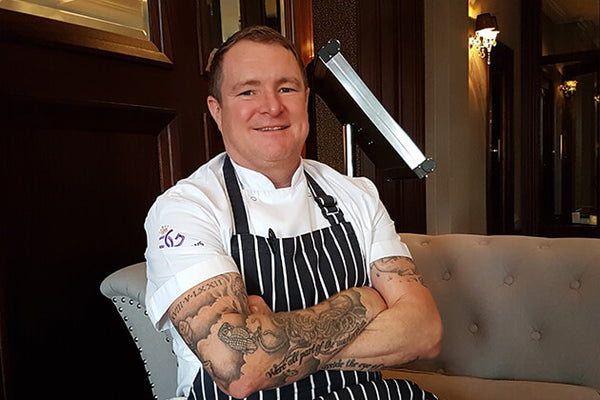
To help get that message across the campaign features the videoabove from Cornwall based Chef Jamie Coleman. This delicious easy cook Sweet 'n' Smoky pulled pork dish, is perfect for slow cooking on a weekend or while working from home. Best of all it’s a great entry level recipe for the pulled pork beginner, and will serve you well for years to come.

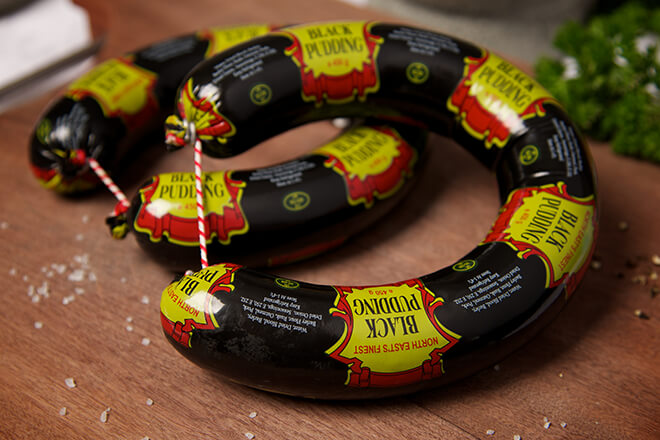
Black pudding is one of the oldest known sausages. Possibly the oldest. There are many varieties around the world, and there is a train of thought amongst butchers that says making a black pudding is possibly the oldest butchery skill.
It’s a tasty roll of heaven that has served us well for generations. It has its detractors, but for us a breakfast has a missing ingredient if it doesn’t include black pudding. We’ve had a deeper look into all things around this bloody majestic marvel.
We’ll get straight to the point. Black pudding is made with blood. Usually pigs blood. While ‘pure’ blood sausages are common across Europe, in Britain we have a long tradition of adding coarsely milled grains like oats or pearl barley to these types of sausages. They ensure that the mixture of stock, blood ground fat and meat has a nice firm consistency when cooled. The grain soaks up the lovely savoury juices and gives the sausage its ‘pudding’ texture.
Blood sausage first arrived in the UK via European monks. They called it ‘blutwurst’ which means blood sausage. As mentioned, it could be the oldest sausage around. It is referenced in 800 BC and the oldest detailed recipe is from the Romans around the 4th Century. Proper old. The name variant of ‘blood sausage’ moved along to blood pudding and then finally to black pudding, with the term ‘blak podyngs’ being recorded in the 15th century.
No. Sorry it's not. There were claims a few years ago that it was, but that was just marketing noise from the fitness community rather than fact. It’s not all bad news though, it is a great source of protein. The fact it’s made of blood makes it naturally high in iron and zinc, both of which are brilliant. Iron helps to metabolize proteins and plays a vital role in the production of hemoglobin and red blood cells. Zinc helps maintain an active immune system, aids healing and helps the body to break down carbohydrates. It’s also packed with potassium, calcium and magnesium, so although not a superfood, it is super food.
Again no. Fat and salt content can be a concern, but as with most things, and especially sausage that varies. Some varieties of black pudding can contain up to 25% fat, whereas the lower end of that scale tend to be less than 3%. As we’ve said many times, sausage is a personal taste. Black pudding is no different. Some people like a different variety. There is no right or wrong. Only flavour.

Rich and velvety, with a flavour that is both deeply savoury but also slightly sweet. It’s not for everyone, and our American friends in particular struggle with the texture (and its main ingredient!).
There is an art to cooking a good black pudding. Generally it is fried, but you can also bake or boil it, depending on if you’re having slices or the whole thing.
To fry, get a shallow non-stick frying pan hot, slice the black pudding thickly at least 1.5cm, then place them cut-side down in the pan with a little oil. Leave the slices to form a nice crust about 3-4 minutes, before you turn them over. This will help hold them together. Be careful when turning and let the other side crisp. When cooked, lightly pat with some kitchen roll.
If you want to boil a black pudding DO NOT slice it first. Bring a pan of water to a gentle simmer then add the whole black pudding and let it cook on a simmer for 6-8 minutes. Don’t let the water boil as it will cause the skin to split and the pudding will take on water. When cooked, remove the pudding from the water and slice to serve.
To oven bake, slice into 1.5cm thick slices, place on a baking tray and pop into a preheated oven at 190°C (gas mark 4) for 6-8 minutes, turning once half-way through.

Now there’s a question! Lancashire is arguably the place most associated with it in Britain. Bury, and Bury Market, if we’re being very specific. Nearby Ramsbottom hosts theWorld Black Pudding Throwing Championships which gives an indication of just how serious they take their Black Pudding in that county. Much to Lancastrian’s dismay, Black Pudding in the UK almost certainly originated in Yorkshire (from the European monks). The Black Country in the Midlands, also has a claim for being Black Pudding Country, but that’s more to do with pork production in that part of the country.
If it’s a pure question of quality, Stornoway Black Pudding takes some beating. In 2013, it was granted PGI status (Protected Geographical Indicator of Origin) by the European Union. This means that producers outside ofthe area can no longer use the “Stornoway” label and it is made exclusively in Stornoway on the Isle of Lewis in the Western Isles or (Outer Hebrides) of Scotland
Although most famously served for breakfast, it’s not the only place for it. It goes lovely with seafood, especially scallops or lobster. It’s equally at home in a hotpot, or is lovely to flavour and beef out mash potato. As pretty basic northerners our favourite is straight from the pan, served on buttered toast, with a dollop of English Mustard.
]]>A classic Greek recipe Tzatziki is made from just a few ingredients, of grated cucumber, olive oil and yoghurt.

Tzatziki, tzadziki or tsatsiki is easier to make than it is to say. A classic Greek recipe it is made from just a few ingredients, of grated cucumber, olive oil and yoghurt. Any other additions are at the cook’s discretion. Once mastered you’ll never go back to the shop bought variety. You’ll serve it at every BBQ you can, as it’s a cracking accompaniment to meat, and especially grilled lamb.
(serves 2)
Put the lamb rumps in a bowl and pour the lemon (or lime) juice over them.Sprinkle over the Moroccan Spice and rub it in, to make sure the whole rump is covered. Use a little bit more if needed. Pop it in the fridge, and let it marinate for at least 30 mins. While it’s marinating and soaking up those lovely Moroccan flavours, you can make the Tzatziki.
Peel a cucumber, using a vegetable peeler, and then cut half. You need to remove the seeds, as otherwise it will change the consistency of the finish, and it just won’t be the same. A teaspoon is sometimes useful for removing the seeds.
When deseeded, you want to finely chop it or even better (and easier), grate it. Then you need to leave it in a colander or sieve with a little rock salt. Salting the cucumber stops the sauce from becoming watery and thin, as it draws out water and gives it flavour. Whether you grate or chop, you cannot skip this step. It’s crucial.
After 10 mins or so, pat the cucumber dry with kitchen towels then stir in a teaspoon of good olive oil and then fold in the yogurt. Season with a crushed clove of garlic and a squeeze of lemon juice.
Cook the lamb rump of the BBQ or grill for 3-4 minutes each side. It’s best to try and flip them the once to allow the meat to caramelise and char. It’s important when grilling lamb on the BBQ that your charcoal is white and at optimum cooking heat. Fat will come out and flame the grill, so you don’t really won’t too many flames when you start cooking. If this does happen and you think the lamb is cooking too quickly or burning, move the steak to the cooler side of the grill.
Once cooked, take the rump from the grill and leave it to rest for 2-3 minutes. This will allow the meat to relax and distribute the juices across the meat fibres. Trust us, you don’t want to skip this step now you’re so close to the line.
Carve the lamb into even slices. Warm the pittas,split them in half, and divide the lettuce and red onion between them. Top with the lamb, squeeze over the lemon juice and servewiththe tzatziki.
Taste the summer at home!
]]>People have been salting and curing meat for centuries (if not millennia). In the main the principals haven’t changed a great deal.

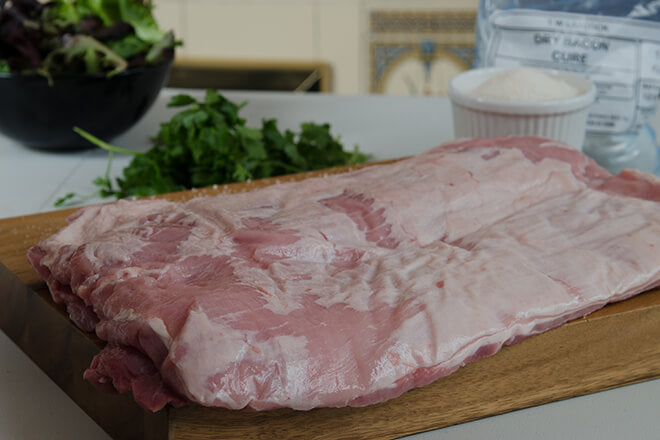
How to make bacon at home is really not that hard. What you do need to have is time (which isn’t a problem at the moment), some patience, and the right kit and equipment. You’ll have to wait a good few days for your work to come to fruition on your plate. The time you spend to ‘make’ the bacon is really quick. It generally takes under ten minutes to (begin) turning a slab of pork belly into delicious streaky bacon.
People have been salting and curing meat for centuries (if not millennia). In the main the principals haven’t changed a great deal. Salt is used to draw out liquid from the meat, so it lasts longer without spoiling.
Although born as a preserving technique, our appetite for salted meat is now flavour based

While every nation has its own take on curing to some extent, and there are thousands of variations, there are still only two essential ingredients needed to preserve meat. Salt and Air. The very best dried ham in the world, regardless of where they’re from, are generally produced with just these two ingredients.
Although born as a preserving technique, our appetite for salted meat is now flavour based, with bacon the curing king. It’s no surprise that most vegetarian converts admit they miss bacon.
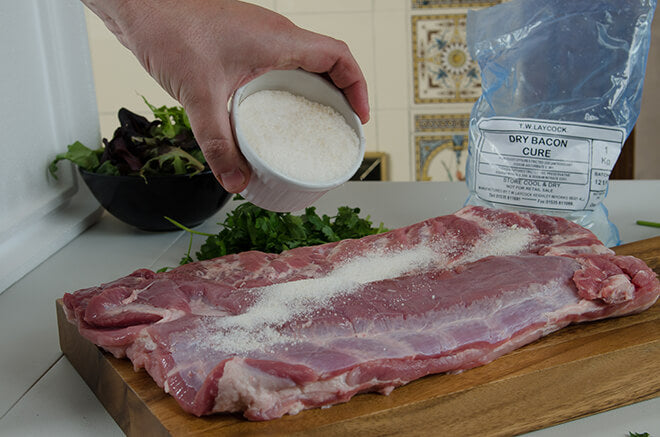
The easiest way to start with making bacon at home is the old fashioned way. Dry curing. This is nothing more or less than the direct application of salt to meat. If you can get hold of some proper curing salt or bacon cure, we’d advise using that. It does contain sodium nitrate, which makes the alluring pink colour, adds flavour and slightly speeds up the curing process.

There’s lots of stockists out there, especially online based. are top guys, and super helpful for beginners. are mainly trade suppliers to butcher shops, but also supply smaller packs, and obviously the ubiquitous Amazon is a source if needed.
If you have an issue with nitrates, you can use regular salt and your bacon will taste fine. Sea salt is generally the best, but the process works with any salt. We will warn you in advance though, if you just use salt, the bacon won’t be pink when cured. That’s a deal breaker to a lot of people as a grey-brown bacon just isn’t what we’re used to seeing or eating.
As a general rule you want to allow 70g salt or dry cure mix to 1kg Pork (7%). So for a 3kg belly you’d be looking at about 210g or for a 2kg pork leg 140g salt/cure mix. That 7% ratio is very subjective, and comes down to personal taste. Add more if you like a saltier taste, and slightly less for a milder flavour, but generally you’ll want a salt/cure to meat ratio of between 5-10%.
As you advance there are any other number of ingredients you can start to add to your own blend. Sweeteners such as sugar, honey and maple syrup are very on trend at the moment, as are aromatics such as bay leaves, juniper berries, coriander and citrus zest. There’s absolutely no rules of engagement here - it’s time to get creative.
Each day for the next seven days, you must flip the bacon once a day.

The only really big DON’T when it comes to dry curing is not to let the salt have any prolonged contact with metal. As such, don’t use a ‘reactive’ container to keep the pork in during the curing process. Any container that will fit the pork joint in will do. A large plastic tupperware would be great or any food-safe container. Even a wooden crate, but we didn’t tell you that if H&S police are reading this.
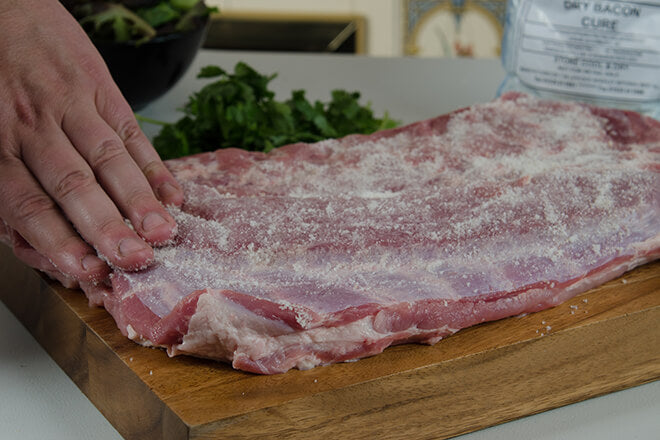
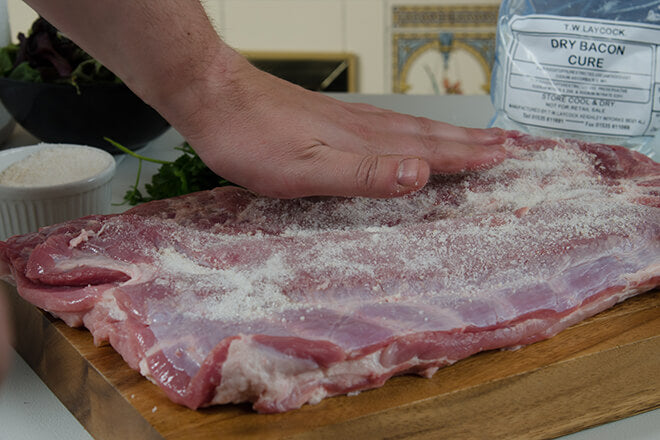
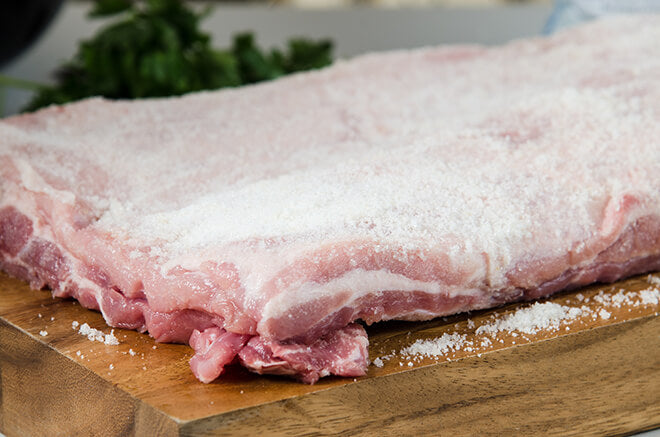
To make the bacon, lay the meat in a shallow food-safe container and rub it all over with the dry cure mix, at a ratio of about 70g per 1kg of pork. It’s a good idea to do one coat on all sides, shake off the excess and let the belly sit for 5 minutes. Then reapply the cure that’s fallen off. You’re best off rubbing it in by hand, so you might want to wear food-safe gloves, although we appreciate they’re scarce at the moment.
Cover the container with cling film, or wrap the pork in cling film and place the container in the fridge.
Each day for the next seven days, you must flip the bacon once a day. You can scoop up and re-apply the dry cure mix all over the meat. This is less important if you’ve wrapped the meat in cling film, but otherwise it needs to be done every day otherwise you’ll end up with unequally cured bacon.
During the curing process you’ll see an increasing take up of water in the container, and you just need to baste the meat with this liquor.
Curing will be complete within 5-8 days depending on the thickness of the meat and the storage temperature. For a regular belly joint, most people usually find 6 or 7 days is about right, but you can leave it longer for a saltier taste.
After 7 days curing, gently wash off the remaining cure mix with cold water, and then pat dry with paper towel.
You then really need to either hang it on a meat hook (probably not practical), or place it back in the fridge for 24 hours. It’s best to wrap it in heavy, breathable butcher’s paper, or a paper bag.
Congratulations, the bacon is now ready for slicing and cooking. If you’re not going to use it in the next 2 weeks or so, it’ll be good to freeze. Slicing bacon that is frozen or partially frozen is actually way easier, so it’s good to do it for that reason alone.
Let us know how you get on, and happy bacon making!

The Sirtfood diet is very much back in the news thanks to Adele. The singer has allegedly been using the diet and when she thanked healthcare workers in the internet went on melt down about her weight loss.
Sirtfood was a breakthrough food regime a few years ago, and was the darling diet with the broadsheet press at the time. If you missed it, the headlines are that it includes red wine, chocolate and coffee. Far less publicised and attention grabbing, (but equally good news in our opinion) is the fact that the answer to the question,‘can you eat meat on the sirt food diet?’, is a resounding, yes. The diet plan not only includes a good healthy portion of meat, it goes on to suggest that protein is an essential inclusion in a Sirtfood-based diet to reap maximum benefit. We’re not advocating this as some meat heavy diet (we still remember the bad breath from Atkins), it’s actually very vegetarian friendly and caters for pretty much everyone, which is what makes it so sensible an option to us.

So what is the Sirtfood diet? It was developed by nutritionists Aidan Goggins and Glen Matten, following a pilot study at the exclusive KX Gym, (Daniel Craig, Madonna and a whole host of other celebs are allegedly members) where they are both consultants in Sloane Square, London. Participants in the trial lost 7lbs in the first seven days, in what the authors call the hyper-success stage. The science behind Sirtfoods falls out of a study in 2003 which found that a compound found in red wine, increased the lifespan of yeast. Ultimately, this led to the studies which explain the health benefits of red wine, and how (if drank moderately) people who drink red wine gain less weight.
Much of the science behind the Sirtfood diet is similar to that of ‘fasting-diets’ which have been popular for the past few years, whereby our bodies activate genes and our fat storage is switched off; our bodies essentially switch to survival mode, hence weight loss. The negatives to fasting-diets are the inevitable hunger that ensues, along with reduction in energy, irritable behaviour (when you’re “hangry”), fatigue and muscle loss. The Sirtfood diet claims to counter those negatives, as it is not a fast, so hunger is not an issue, making it perfect for people who want to lead an active healthy lifestyle.
Sirtfoods are a (relatively newly discovered) group of foods that are powerful in activating the ‘sirtuin’ genes in our body, which are the genes activated in fasting diets. The book lists the top sirtfoods as birds-eye chill, buckwheat, capers, celery, coffee, green tea, and kale among others (buy the book if you want them all), and outlines a 21 day diet plan that is very high in the top 20 Sirtfoods. Crucially for us carnivores, the book goes on to suggest in the chapter entitled ‘Sirtfoods for Life’ that protein is essential to maintain metabolism and reduce loss of muscle when dieting. Leucine, is an amino acid found in protein, which compliments and actually enhances the actions of Sirtfoods. This means that the best way to eat Sirtfoods is by combining them with a chicken breast, steak or other source of leucine such as fish or eggs.
The book goes on to suggest that poultry can be eaten freely as much as you want (because it is an excellent source of protein, B vitamins, potassium and phosphorous), and that red meat (another excellent source of protein, iron, zinc and vitamin B12) can be eaten up to three times (750g raw weight) a week.
Overall we can totally see the benefit and appeal of the Sirtfood diet. Like pretty much any diet plan, it can be a faff getting all the ingredients, and and the ‘Sirtfood green juice’, which forms a core part of the first 14 days of the plan, is a pain to make and pretty expensive, but it does tastes surprisingly better than you’d expect. We only trialled a few days of the plan, and while there was noticeable weight loss, the real benefit of the book is the sensible approach of introducing Sirtfoods into your everyday meal planning.
The Sirtfood diet is available on, and it really is a good read full of clever helpful nutritional advice, even if you don’t want to follow the 21 day plan.
]]>The country is about to celebrate the75th anniversary ofVE Day in very different circumstances due to lockdown.There will be lots of scaled back garden celebrations, and we thought it was high-time we made the case for celebrating with a quintessentially British tradition. Great British Coronation Chicken.

It's much easier to make than you think, and it tastes far superior than a shop bought variety. It's guaranteed to spice up your day, and by starting your own family tradition, you certainly won't go back to shop bought again.
Created in 1953 , it was a popular party dish in the 1970s and 1980s. Nowadays Coronation Chicken probably isn't held insuch high regard, but we think it should be.
It's reputation was damaged,mainly because of substandard buffets the length and breadth of Britain, and the fact that we don’t cater for flavour enough at a buffet now. If it’s not a beige food, that comes pre-cooked it probably won’t make it to the buffet table - (before you start we do realise the irony here as Coronation Chicken is browny beige itself, but you know what we mean).
You really should give it another go if you are having a family gathering to celebrate VE Day. It's much easier to make than you think, and it tastes far superior than a shop bought variety. It's guaranteed to spice up your day, and by starting your own family tradition, you certainly won't go back to shop bought again. You can use whatever heat curry powder you want depending on taste. We've used Madras which gives a lovely spicy kick, but you can tone that down if you prefer.
(Serves 6)
Cook the chicken in your preferred way. We like to steam it scattered with the lemon zest for 25 minutes, to give it a juicy flavour. When it’s cooked, set it aside to cool.
In a small pan, melt the butter and then add the shallot or onion and cook gently for 4-5 minutes until nice and soft and translucent. Stir in the curry powder, tomato puree, wine and lemon juice. Simmer uncovered for about 5 minutes until the liquid has reduced by at least half.
Take the pan off the heat and then stir in the apricot jam, mayonnaise, yogurt, coriander and salt and pepper to taste. Mix thoroughly and then set the pan aside to cool.
Fold the chicken into the mixture with a wooden spoon or spatula. If the chicken is diced larger than you’d prefer on a sandwich, cut it into smaller bite size pieces.
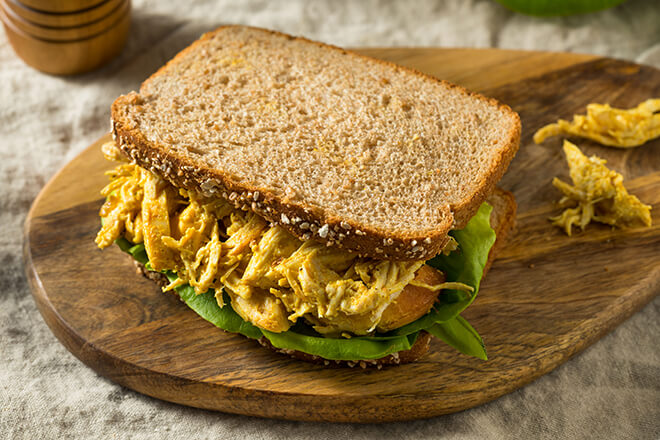
Adjust the seasoning to taste and serve on whatever type of bread you fancy - sourdough, naan, or pitta all work well, but our favourite is on a nice fresh bread roll, cut in half and served as an open sandwich, with some green salad - old skool buffet style!
Happy Eating :-)

Cheaper beef cuts work much better in burgers to give maximum flavour. The key is getting the optimal beef-to-fat ratio. That’s what a butcher spends years and years perfecting.
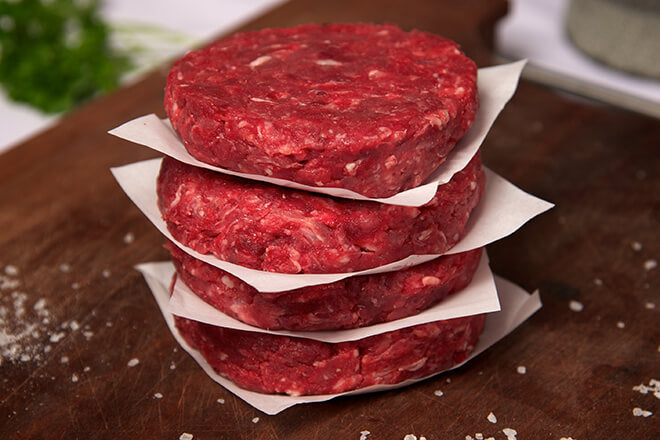
The most important part of any burger is the meat. This sounds ridiculously obvious, but it really is true. A lot of self-appointed burger experts will try and dazzle with fancy burger blends. The more expensive a burger is, chances are it’s made with more expensive beef. $150 plus burgers are almost certainly made using fillet steak, probably from Kobe beef, or other high end, celebrated beef cattle. They’re only expensive because of the luxury and scarcity. It’s basically a burger for people who want to pay $200 for a burger. Probably in Las Vegas or Dubai. Each to their own, but for burgers they’re the wrong cuts of meat, and a total waste of money.
Cheaper beef cuts work much better in burgers to give maximum flavour. The key is getting the optimal beef-to-fat ratio for your palette and personal taste. That’s what butcher’s spend years and years perfecting. If you have a local butcher, they’ll help you create a blend to your specifications, but most are pushed for time right now, so try and be patient.
So here’s our top burger tips to look out for when grilling at home during lockdown;
As we mentioned, cheaper cuts tend to make the best burgers. Fact. Much of it comes down to personal preference, but in general, you want to be looking for harder working muscles like chuck or flank steak. Cuts like this tend to have more myoglobin in them, which is the iron-oxygen binding protein that’s responsible for giving beef its red colour and ‘beefy’ flavour. More importantly, they also have a naturally optimal meat to fat ratio for burger making. More luxurious cuts like rump or ribeye, can undoubtedly be used, but you’ll have to play around with fat ratios.
Our two favourite cuts for making burgers are…
CHUCKChuck steakis the main cut we use for our Premium and GastoBurgers. It’s found at the top of the shoulder in the cattle, and has lovely tissues of fat running throughout, which baste the meat when cooked, to give it a natural juiciness. It’s got a lovely steak-tasting flavour, but as it’s got more texture from the juicy fat, the steak taste doesn’t overpower things.
BRISKETPopular with our trade customers (back in the days before lockdown!)brisket is from one of the most used muscles, which is why it's so revered for slow-cooking BBQ. Again it has a natural fat-to-beef ratio and has a bold taste and flavour. It’s not to everyone’s taste, and kids sometimes find it slightly overpowering, but adults usually love it, and it works really well with darker beers and red wine.
While dry-aged meat is undoubtedly the best it comes with a word of warning when being used in burgers. If the aged layer on the outside of the beef (it’s actually mold, but we didn’t want to say that!) hasn’t been properly removed and gets into the burger mix, it won’t taste nice. At all.
As beef dry-ages it loses moisture, but moisture in a burger isn’t a bad thing. Again it comes down to personal taste, and the butcher’s experience and opinion. Dry-aged meat will undoubtedly give a stronger beefier flavour, but drying meat to be used in burger for too long is minimal gain.
The texture of the burger will almost certainly come from the grind. We think the best grind is when the meat goes through a medium plate on the mincer - twice! It depends on the cut, but for chuck and brisket, that’s our preference.
A cheap burger from a big retailer or supermarket will try and hide the amount of fat used by mincing it over and over, until it becomes mush and paste (urgh). Make sure you look on the label - there should be no hiding.

We think the best grind is when the meat goes through a medium plate on the mincer - twice!
While you don’t want too much (see above), in general, when it comes to burgers - Fat is a Friend. It gives juiciness, it gives flavour, and that is why the beef-to-fat ratio in the minced grind is so important. You want to be looking for around the 80/20 or 70/30 ratio. Depending on how you like to cook and serve, the standard rule is that more meat is better for medium-rare to medium, and more fat for medium-well and well-done. If you like a rare burger, you’re definitely better making them yourself with a high meat and low fat content of 90/10.
Seasoning is essential to getting a ‘burger’ taste rather than just mince. At a minimum you’ll need some salt and pepper, but you can include pretty much anything and everything you want depending on your creativity. There are some great ‘off-the-shelf’ dry-mixes out there now too if you’re looking for an easy place to start.
If you prefer a more freestyle approach, wet ingredients such as finely chopped onion, ketchup, mustard and Worcester sauce will also make for a juicier burger. It’s really important to make sure the seasonings are dispersed throughout the meat, not just on the surface. To do this, you’re best off rolling your sleeves up and mixing the burger mix by hand. Ideally you only want to use your fingertips mixing things in gently so as not to compress the texture or work the meat too much at this stage.

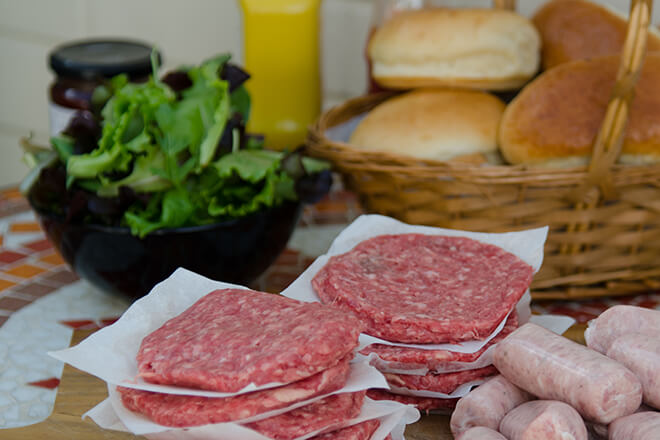
Our top tip for shaping your own burgers at home - is get a burger press. They’re not expensive, but like most things you get what you pay for. A plastic one will do the job, but if you can, get a proper 6oz/170g handheld burger press. It’ll last an age, you’ll enjoy it during lockdown, and you’ll look like a pro when guests finally come round to your BBQs again.
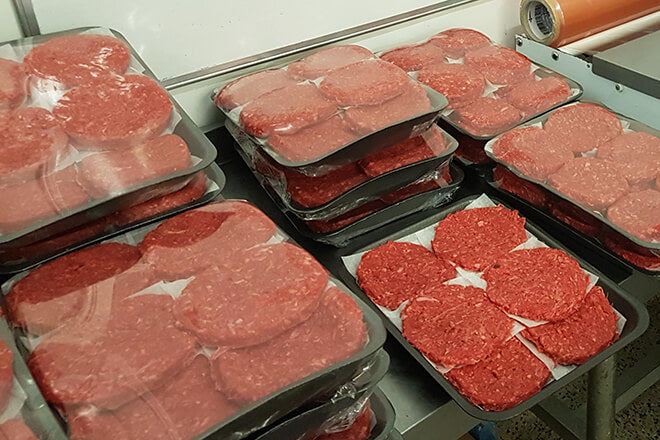
A 170g/6oz moulded press is our optimal plate size, as it’s the perfect thickness to cook and serve how you like them, getting some bbq charing on the outside and juicy in the middle. Smaller burgers are thinner, and can’t really be cooked to liking, especially not medium or medium rare. And bigger burgers are just a bit - big and odd.
If you’ve not got a burger press, be pretty gentle when shaping the meat. You don’t want to overwork the meat, which is why a press is much superior for the job. Divide the meaty mixture into equal portions, forming a loose round ball, about the size of a tennis ball, then gently flatten it until it is about 2cm thick.
Burgers often puff up in the middle when cooking on a high heat bbq and you can get left with a meatball if you’re not careful. To avoid this, press a shallow dimple indentation in the middle of each raw burger using your thumb or the back of a spoon. Again, you’re better still use a burger press, as that has the indent built in. As the burger cooks on the grill it will fill in and flatten out to a level surface, rather than blowing out.
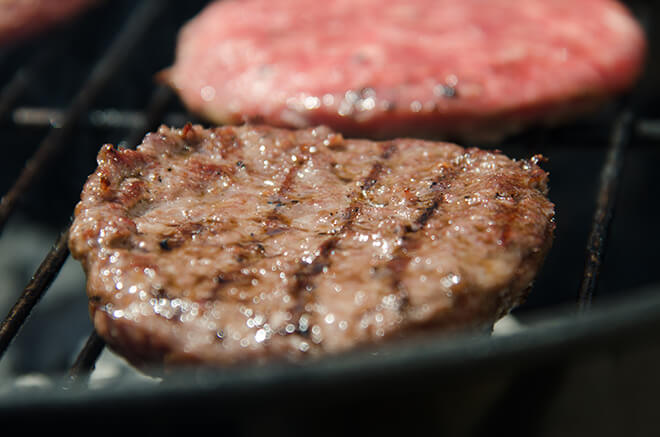
Burgers often puff up in the middle when cooking on a BBQ...to avoid this, press a shallow dimple indentation in the middle of each one
While brioche was all the rage a few years back, we think they’re just a bit too sweet. A classic white bap from a good local baker is your best bet. You want to match the bun to the size of your burger. If it's too small, it’s difficult to eat when you’ve added salad and condiments. At the same time, too big and you taste too much bread each bite. Toasting the buns on the grill is again personal preference, but easy to burn, so we give it a miss.

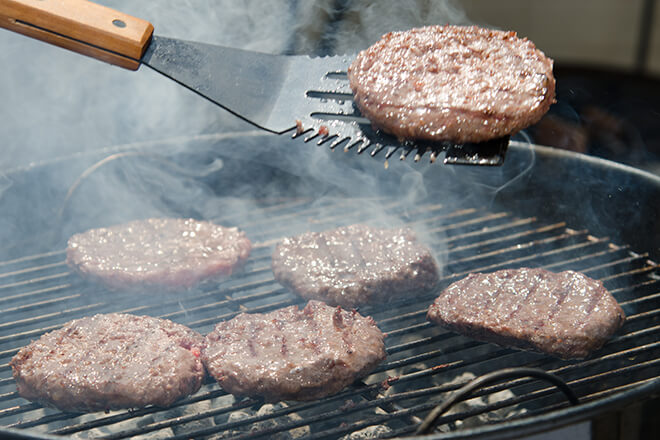
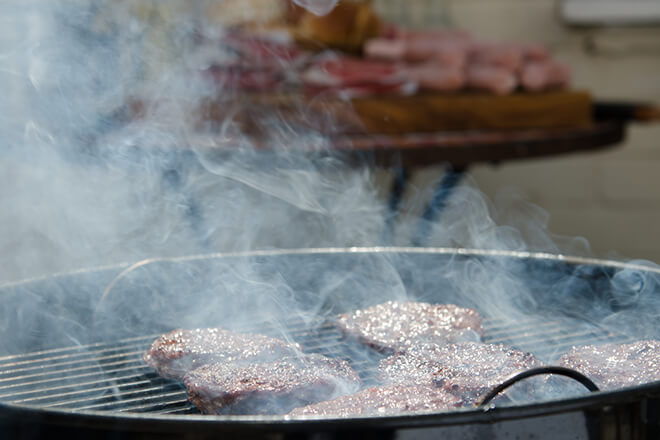
You need to preheat the grill. If you put burgers on a cold grill they will stick to the grate, and you can forget about getting those lovely grill marks we all aim for. You want the grill on the hot coals or burners for at least 10-15 before you start cooking.
You have to treat a good burger on the BBQ with a bit more love and attention, and be patient. For a juicy, medium cooked burger, you want to cook them for about 4-5 minutes each side (8-10 minutes in total), on a hot grill. It is best not to constantly flip the burger. You just want to turn them once or twice otherwise you run the risk of ripping the burger surface before it has formed a tasty crust.
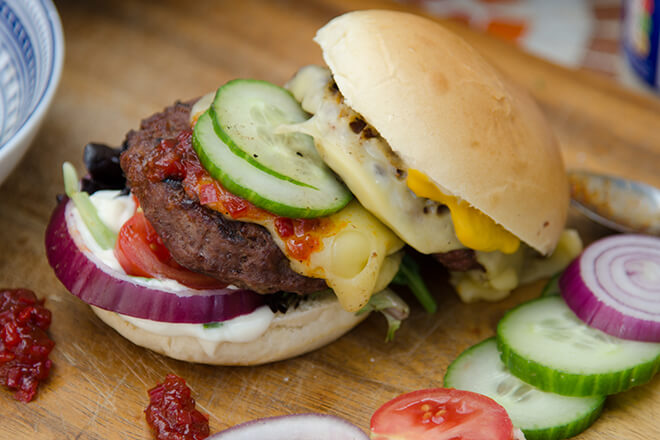
If adding cheese, do this once cooked, and when on cover the BBQ with the lid for about 30 seconds, (or use a heatproof bowl) to allow the cheese to melt over the burger. Take off the grill and pop the patty into the bun.

For a juicy, medium cooked burger, you want to cook them for about 4-5 minutes each side
---
So there you have it. That’s our butcher’s guide to perfect lockdown burgers. Enjoy with the family. Think of your friends. And almost certainly enjoy the beefy flavour with a nice cold drink!
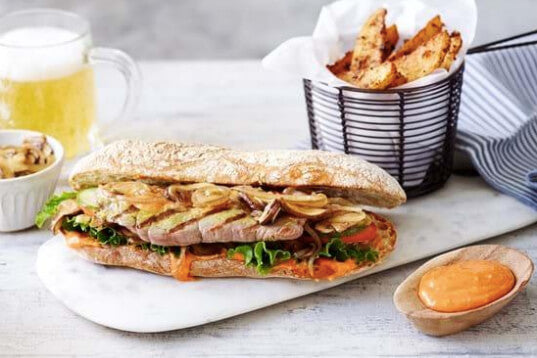
]]>This recipe uses thin cut beef steaks, and is topped off with some caramelised mushrooms, to give it more depth and bite.

This delicious steak sandwich recipe is adapted from our friends over at . The website is a hive of meaty treats, and is perfect for anyone looking for recipe inspiration at this time.
This recipe uses thin cut beef steaks, and is topped off with some caramelised mushrooms, to give it some more depth and bite. It's finished by being smothered in a homemade relish, but you could just as easily use a shop bought relish of your choice.
Prep Time: 20 mins
Cook Time: 10 minutes
Servings: 4
For the relish
Remove the steaks from the fridge at least 20 minutes before you’ll be cooking them to let them get up to room temperature. Slice the steaks thinly against the grain, then transfer them to a plate or bowl.
Pour in 1tbsp olive oil and add the mustard and give the steak slices a good stir (or use your hands), to make sure the slices are nice and coated. Cover and leave to one side.
To cook the caramelised mushrooms, heat the remaining 1tsp of oil in a large pan and cook the onions and mushrooms for 4-5 minutes under a low heat until they’re nice and soft. Add the sugar and the balsamic vinegar. Cook for another 5 minutes until slightly caramelised. Remove from the heat and transfer the mixture to a small bowl.
Meanwhile, to prepare the relish, get a small bowl and mix all the ingredients together and set aside.
Return the pan to the heat until hot, you don’t need to add oil, as that’s on the steak. Cook the steak slices for 3-4 minutes or until your liking.
Cut the bread in half and spread with the relish and salad. Top with the steak, caramelised mushrooms and onions and top it with some more relish.
Serve with chips or wedges and some extra relish for dunking.
]]>
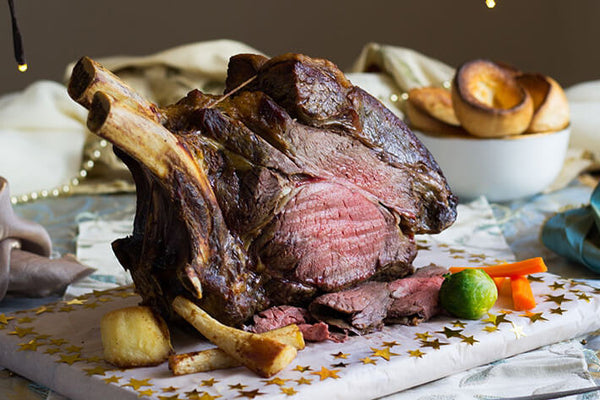
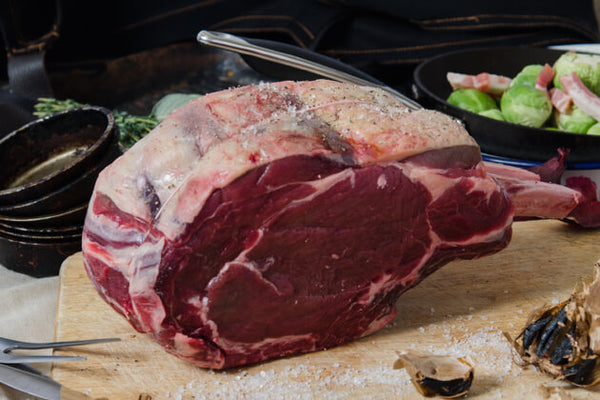
Very popular as a Christmas joint nowadays, whether you call it a Bone-in-Forerib, a Rib of Beef, or just the daddy of all beef joints, you are in for a treat.
If you want to know how to cook rib of beef, you need to appreciate that for many chefs, a bone-in rib of beef is the rolls-royce cut, and is their default choice for a roasting joint. On the bone, the ribs serve as insulation from the harsh heat of the oven and provide anchorage for the meat that prevents shrinkage. Cooked from room temperature, in a hot oven, the outside will char beautifully with a decent layer of golden fat, and the inside will cook to perfection with a little rare meat for those who like it, and the entire joint will flood with deep savoury flavour from the internal fat. No other joint has all of these qualities which point to the perfect roast. Here’s how to cook a beef rib roast.
First you need to remove all the packaging and give the meat a good dry. You can do this by letting it stand uncovered, but it is quicker to use some kitchen paper. Then you need to leave it out of the fridge to come up to room temperature. Most cookery books and guides provide meat timings from fridge cold so you need to be aware of that when cooking from room temperature. When beef goes through the aging process it is the work of enzymes that improve the texture and flavour; by leaving the joint out and uncovered you are giving those enzymes some time to relax which gives them more chance of working their meaty magic, giving you a lovely succulent joint when roasted.
Before you start to cook a rib of beef, you need to do a little bit of prep and research first, and work out how long you need to cook it for. To do this you need to know the weight of the rib joint. You need to calculate the cooking time by allowing an initial 20 minute blast on a high heat (220℃) and the 20 minutes per 500g for medium, 15 minutes per 500g for medium-rare, and 10-15 minutes for rare, at 170℃. Our advice is to go for medium or medium rare when cooking at home as this way you’ll have some well-done meat for those who like it that way (usually the kids), on the outside and some pinker meat towards the centre of the joint, meaning that all bases are covered. If you have a fan oven the temperature will need to be reduced usually, a reduction of around 20℃ is required but every oven has its own idiosyncrasies.
Preheat the oven to 220℃/gas mark 7
Give the layer of fat on top a good seasoning with salt and pepper, and a nice tip is to rub it with English mustard powder so that it cooks to a lovely golden crust.
Pop the meat on a roasting tray, standing on its end with the ribs pointing skywards. Due to the height it will probably need to go on the bottom shelf of the oven. Give the beef a 20 minute sizzle in the high oven at 220℃/gas mark 7 then turn the oven down to 170℃/gas mark 3 and time the cooking of the joint from this point.This really gets the browning process started and the caramelisation of the surface on its way.
You should try and weight the joint yourself, but an average size two bone rib of beef is approx 2.5kg so you could use the timings below for this size
For a more accurate doneness you want to use a meat thermometer and you’re looking for an internal temperature of 50℃ for RARE 60℃ for MEDIUM 70℃ for WELL DONE
If you are not using a thermometer, check to see if the meat is cooked to your liking about 20-30 minutes before the end of the cooking time. The shape of the joint might mean it cooks a little sooner than the calculated time. A check you can do is to push a skewer through the thickest part of the joint and leave it for 10 seconds. Take the skewer out and touch it to your inner wrist; it will be just warm for rare, warm for medium-rare and hot for medium (obviously take care not to burn yourself here). If you don’t want to risk the heat on your wrist the colour of the juices from inserting the skewer are also a sign. The redder the juices, the rarer the meat. For a medium roast you can expect a flow of clear juices mixed with a little pinkish blood. You could also press the meat but for a joint of this size you will need to press from both sides. The more spring in the flesh, the rarer it is. The perfect medium joint will feel quite taut, with just a small amount of spring radiating from right in the centre. Don’t forget that the meat will continue to cook as it rests, and the juices will also become more evenly distributed, so don’t leave it cooking too long.
When it is cooked, you need to let it rest for at least 20 minutes.This step is non-negotiable, and is essential to allow the meat to relax and distribute the juices evenly, and it will also allow you time bring the rest of the meal together and free up the oven for the roastes etc.
Although your meat will be tender however you choose to carve it, rib of beef is best when carved reasonably thin, like this;
Serve with whatever you think is best, but it will almost certainly involved gravy, Yorkshire puddings, horseradish sauce, roast potatoes and some vegetables.
]]>
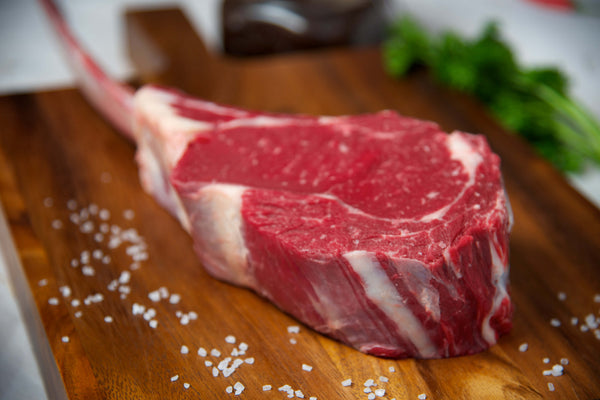
What is aTomahawk Steakyou ask? You probably think a Tomahawk Steak is a steak you’ve heard of but haven’t actually eaten? There is no need to second guess yourself, few people have tried aTomahawk, and if you had you certainly wouldn’t have forgotten, as it is the ultimate ‘wow-factor’ steak. Named because it allegedly resembles the Tomahawk axe, Tomahawk Steak is becoming more common here in the UK, and although it isn’t very common on restaurant menus, (mainly because of price) you can usually get one at an upmarket steakhouse these days. It is popping up in more places for the home cook and you meat fans to get hold of, with even Marks and Sparks jumping on the bandwagon.
The Tomahawk Steak is an on-the bone Rib Steak, cut from the Fore-rib with the entire rib bone left. The long bone is french-trimmed, leaving an amazing presentation, and dinner table discussion point. As it is bone-in Rib Steak, it has quite a large amount of inter-muscular fat, which gives it a load of flavour when cooked, as flavours are released from both the huge bone, and inter-muscular fat during roasting to give a sweet gelatinous flavour.
The Tomahawk is cut based on the thickness of the rib bone and is usually 5cm/2 inches thick, weighing approx 1.2kg. A Tomahawk makes an ideal sharing steak for a special occasion or romantic meal, as it can easily feed two people. If you like bone-in steaks such as T-bone or Porterhouse, you’ll love the Tomahawk Steak as the primary muscle is the longissimus dorsi (back muscle), which is also the main muscle on the T-bone and Porterhouse.
Although technically a steak, at 1.2kg the Tomahawk many people oven roast this, because it can be awkward for frying as it is so large. If choosing to oven roast, you’re best off searing it all over in a large frying pan first (you might not need any oil/fat just a pretty hot pan), before transferring to a hot oven (200ºC) for 15 minutes. Arguably the best method for a Tomahawk Steak is to grill on a barbecue, and using an internal meat thermometer cooking until the optimum temperature for Medium-rare is achieved (58ºC).
Because of it’s size it needs to be properly rested after cooking, for at least 10-15 minutes, to allow the heat from the bone to redistribute across the meat to give a lovely succulent juicy steak.
When cooked and rested, hold the bone in one hand and cut along the bone lengthways to separate the meat from the bone. Slice the meat across the grain into slices as thick as you need them and serve. It's certainly not an everyday steak, but then again it's not everyday you get to eat like The Flintstones.
]]>this is definitely a recipe for a weekend or holiday when you’ve got time on your side, but trust us it’s worth it as the results will likely be remembered for a lifetime.

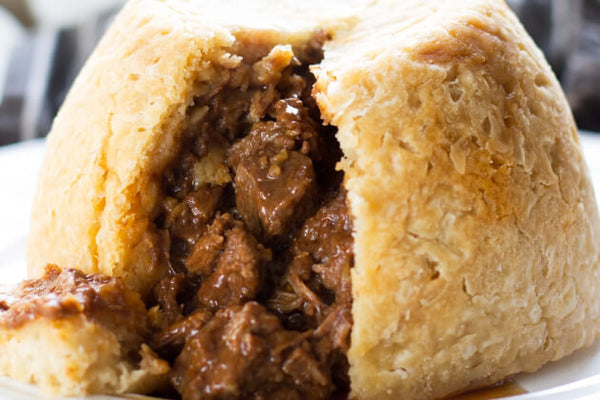
Steak pudding is one of the great foods from yesteryear and is a real British culinary tradition that we think should be more in favour than it currently is. Yes it is pretty calorific, but nothing evokes comfort eating more than a traditional steamed steak pudding. Lot’s of us will have cherished memories of meals such as this round our grandparents tables, and by embracing such foods as your own you can carry on a great food tradition with your own family. Making a suet crust is far easier than you think, and basically if you can make dumplings, you can make suet pastry.
The steak filling will take a good few hours to reach perfection, and the pudding itself needs steaming for a further two hours, so this is definitely a recipe for a weekend or holiday when you’ve got time on your side, but trust us it’s worth it as the results will likely be remembered for a lifetime. We have used IPA instead of a traditional ale, as it’s rounded flavour cuts through the richness, but any ale or beer you have will do the job just fine.
For the pastry
Start by making the filling. Put the beef in a large bowl and mix in the flour so all (or most) of the diced beef has a nice thin coating of flour. Heat 1 tsp oil in a large heavy based pan and brown the meat all over. You might need to do this in batches otherwise you’ll overcrowd the pan, so add the other spoonful of oil for the second batch, and use more if needed. When the meat is browned, put it to one side, and cook the onions over a low heat until softened for about 5 minutes, giving them a stir as you go along. Stir the browned meat back in the pan with the onions, and give everything a good stir around.
Pour in about a third of the beer to deglaze the bottom of the pan, stirring it hard with a wooden spoon to lift any sediment off the base of the pan. Pour in the rest of the IPA along with the beef stock, tomato puree, bay leaf and a good pinch each of salt and pepper. Bringing it to the boil, then simmer gently over a low heat for 2 hours, giving it a stir every 30 minutes or so. The sauce (or more to the point the gravy) needs to thicken at this point so don't rush it.
Set aside to cool completely.
When you are ready to make the pudding, start by greasing a pudding basin (approx 1 litre size). Then in a large bowl, mix the flour, suet and baking powder, with a pinch of salt and pepper. Pour in most of the water and mix it (ideally using one hand if possible) into a soft almost sticky dough, adding more water if needed. Divide the dough into two pieces - roughly three-quarters and one-quarter.
Dust your surface with flour and roll out the larger piece of dough into a circle about 30cm in diameter. Use that piece to line the pudding basin, leaving the excess pastry hanging over the edge of the bowl.
Roll out the smaller piece into a circle, big enough to form the lid for the basin. Spoon or ladle the cooled steak filling into the pastry-lined basin, and then dampen the edges with some water before placing the lid on top. Press the edges together with your fingers and trim away the excess pastry. If you are feeling confident, and want a traditional finish, you can crimp the edges to ensure a good seal.
Next place a large piece of parchment paper on a sheet of foil (or use parchment lined foil) and make a large pleat in the middle, folding both sheets together. Lay the parchment and foil over the top of the pudding basin (foil side up) and secure it with string, looping the string over the pudding and tying it to form a handle that you can use to lift the pudding in and out of the saucepan.
Stand the pudding in a large pan, and pour in boiling water so that it comes to halfway up the side of the pudding basin. Put a lid on the pan and bring the water to a simmer. Lower the heat to maintain a simmer and steam the pudding for 2 hours (maybe 30 minutes longer). Top up the boiling water if needed during the steaming so the pan doesn’t dry.
Lift the basin out of the pan, then take off the foil and parchment and leave it to rest for 5 minutes. To get the pudding out of the basin, run the tip of a small sharp knife around the side of the pudding to release it from the basin. Put a large plate over the pudding as an inverted lid, and turn the plate and pudding over, so the pudding comes out on the plate.
Serve it straight away with whatever your comfort veg of choice is, but we think creamy mashed potato, carrots and broccoli are great.
]]>We’ve found using good old Scotch Whisky is actually better at cutting through the gelatinous and creamy flavour of slow-cooked pork. We think it gives it a more rounded flavour, and balances better against the sweet flavours of the meat rub.

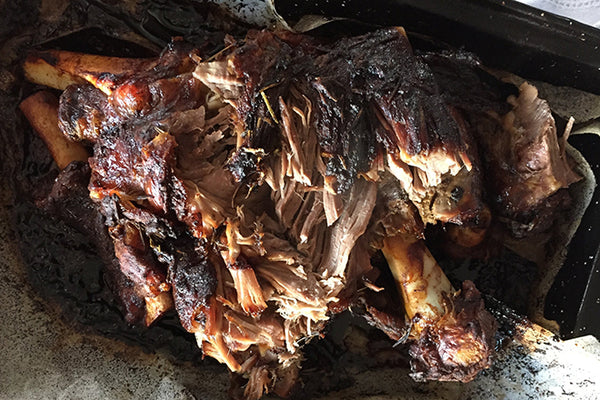
Bourbon (and in particular JD) tends to be cited as the perfect extra added ingredient for pulled pork recipes. We’re not sure whether this is due to geography, clever marketing or genuine preference, but we’ve found using good old Scotch Whisky is actually better at cutting through the gelatinous and creamy flavour of slow-cooked pork. We think it gives it a more rounded flavour, and balances better against the sweet flavours of the meat rub.
You can use pretty much any meat rub you want on this recipe (Cajun, BBQ, Chilli etc), or even make your own, which is super simple to do by combining 2 tsp salt, with 2 tbsp dark brown sugar and 2 tbsp paprika. We’ve used our Fire-Pit BBQ Rub as it works great with the sauce created by the whiskey and coke, but feel free to try your own, we’d love to hear what you come up with.
Serves 8
Prep time : 20 minutes
Cooking time : 8-9 hours
Ingredients

Cooking Instructions
Remove the string from the pork, and unroll it. It is best to remove the rind and the skin with a sharp knife when it’s going in a slow cooker. You don’t need to get it all off, and it doesn’t need to be expertly cut, just get the majority of the rind off before cooking. That said, some people like the rind left on during cooking as they think it helps with basting. In that case, remove it at the end before shredding - it’s entirely up to you.
When the pork is unrolled, pat it dry with kitchen paper, and then sprinkle the rub on. It’s called a ‘rub’ for a reason so you need to get your hands dirty and rub it all over the pork, massaging it into the meat for the best flavour. Don’t be gentle with it, you can’t break it, get stuck in and rub it into the meat for maximum flavour. Roll the meat back up as best you can, but you don’t need to re-tie, it is good to go as it is.
Put the pork joint in a slow cooker, and pour in the whisky and coke, and then cover with the lid. You want to cook it on low for 8-9 hours, until it is nice and tender, falling apart and ready to be pulled. This means you’ve pretty much got the full day to do what you want while it is cooking, which could even involve going to work!
When it is finished, take the pork from the . Cut off and discard the rind (if you haven’t already), and wrap the pork in foil, and leave it to rest for 30 minutes. It is really important you don’t skip this step, as it is during this resting period that the real ‘meat magic’ happens and the juices are evenly distributed. This is what gives you that lovely juicy flavour we all love with pulled pork, so we’ll say it again - please do not skip this step!

Pull the pork by shredding it with two forks, to give you beautifully tender pulled pork. You can stir in a couple of spoonfuls of the cooking juices if you wish to add some more moisture to the pork, which is what we like to do. If you’ve cooked with the rind on, we’d advise not to add any liquid as the juices will likely be fatty (which is another reason you might want to trim it off before cooking).
Serve in bread rolls, with as many side dishes as you like, coleslaw, potato salad, sweet potato wedges and corn on the cob being some obvious choices from our friends in America, but we think there is something amazingly simple about serving it with a good dollop of apple sauce and some quick stuffing.
Happy eating :-)
]]>
"The best thing was to find a young sensitive-looking chick, and when she went to the bog, put an eyeball on top of her can of Coke... they would go crazy when they saw that shit."
Before he became The Prince of Darkness, and was just simple old John Michael "Ozzy" Osbourne, he worked in an abattoir in Birmingham for 18 months in 1964-65.
In his 2009 autobiography , he recalls that although he didn’t like it at first, this was the first job he was good at, and the first one he enjoyed. He was promoted to slaughterman, and goes on to explain how he went on to specialize in cutting out cow's stomachs for overnight soaking, pulling off hooves, and killing pigs.
His party trick on payday in the pub was to sneak cow eyeballs out and drop them in people's drinks. "The best thing was to find a young sensitive-looking chick, and when she went to the bog, put an eyeball on top of her can of Coke... they would go crazy when they saw that shit."

Most famous as Downton Abbey's Mr (John) Bates, Coyle was the son of a butcher and might never have made it to the screen if it wasn’t for the death of his father when he was just 17 years old. It sounds like he wasn’t a big fan of the meat trade though, as speaking to he said he “worked at my dad's butcher shop from a young age and after I started school, I went to a meat factory and did all that. It's really weird, because I hated it at the time. I just wasn't cut out for it."

The Author of the children’s books Horrible Histories (and CBBC adaptation) was a butchers boy in his fathers shop in Sunderland in the 1950s. It is believed the experience helped shape his now infamous dark sense of humour. In an newspaper in 2006 he said
"The thing I particularly enjoyed was carrying a whole sheep on my shoulder and putting it in the freezer; I felt like Superman. That was dangerous too: it was a source of fascination to me that you could die pretty quickly if you were locked in. There was an exit button inside it but you couldn't see it, as the light went out when the door was closed."
By the time he was eight, he was making deliveries to the nearby streets in Sunderland on a bike, "It was a shipyard area and so was bombed in the war. Some of the houses had no external doors. In the summer, the children ran around with no trousers. I still remember clearly the smell of the houses: dead cats and vinegar."

The man the Super Bowl trophy is named after may not be a household name in the UK but in the USA he is reverend as a legend both on and off the field. He is considered by many to be the greatest coach in American football history, and is recognized as one of the great coaches in the history of sport.
The son of a butcher in 1920s New York, from a young age he helped his father in the family shop in the Meatpacking district of Manhatten. He quickly learned how to lift enormously sides of meat around and how to cut up the carcasses. It is a job he apparently wasn’t not fond of, but he did acknowledge that the weightlifting aspect of the role helped to shape his young body, an asset that would later come to his aid as he became interested in sport.

It turns out that working in a butcher’s shop was One Step Beyond for Suggs and led to him pursuing a career in music.
When he was 16 in 1974, Suggs worked part-time in at a butchers shop in London, and ended up working 6 days over the summer earning ĢƵ11 a week.
Speaking about the experience to the in 2012 the Madness lead singer said...
"My job was to take all the metal trays to the backyard and clean them, which meant scraping the blood and fat off them and washing them with cold water. It wasn't very nice."
"Then I got a new role, which meant I had to take all the horrible bits of a pig, including the ears, snout, bollocks and bumhole and feed them through the mincer to make something new and incredible that they called hamburgers. I'd do this under the cover of darkness and it was pretty horrible work. It's amazing what you find in a sausage. I could have chopped my finger off, wrapped it up in a sausage and you wouldn't know the difference."
----
So that's it, our meaty roundup of famous butchers. As we said earlier, it's definitely not for everyone, but it hasn't done this lot any harm by all accounts.
Drop us a line to hello@greatbritishmeat.com if you think we've missed any off the list, and we'll chop this article up and include them!
]]>In the last century, the human diet has changed more dramatically than at any other time in our existence. As food became cheaper and more available, we increased our calorie intake and became a larger and heavier society. Until fairly recently animal fat was an important part of our diet, but then it became ‘healthy eating’ enemy number one, and we hugely reduced the amount of animal fat we ate.

We now eat more trans fat, more sugars, more processed foods, and more vegetable oils than at any other time in history. Yet after more than 30 years of reducing the intake of animal fats, we are not healthier, just heavier. We need to stop and have a think about what we are eating and why. Our experiment with reducing fat hasn’t worked, it’s just made food taste worse.
It turned out that diets low in fat, leave people feeling hungry, depressed and prone to illness and weight gain. We replaced the reduced animal fat in our diet with sugars and other refined carbohydrates, which essentially got us fat. We replaced animal fats with man-made hydrogenated fats which are full of trans fat, which are difficult for our body to break down and process, so instead we store them as fat. They increase LDL and lower HDL which adversely affects cholesterol, and they promote diabetes and obesity by interfering with insulin production.
The other fats we’ve replaced animal fats with are polyunsaturated fats, used for cooking oils. As well as damaging cells, polyunsaturated fats have affected the balance of essential fatty acids (omega-6 and omega-3) in our bodies. Nutritionists recommend ideal consumption of twice as much omega-6 as omega-3 would be most beneficial to us, but we’re currently consuming up to twenty times more omega6 than omega-3, which has been linked to all kinds of issues such as cancer, weight gain and digestive issues. Sources of omega-3 are decreasing, such as meat and butter from grass-fed animals, whereas animals raised on a diet high in grain are full of omega-6.
Fear of fat is pretty much engrained on us, and we must try and alter this perception. While human nutrition is naturally complex, and no two bodies function identically, for the majority of people, eating fat isn’t the ‘health risk’ it was supposed to be. In fact, fat is good.
We need to re-evaluate our relationship with what we eat. Society has become so disconnected from the source of our food that we have now have less knowledge about where it comes from, how we buy it, how we cook it, and what and when we should be eating things. In the simplest terms, our generation has lost the ability and skills required to cook simple meals from scratch. We understand that we have to eat, but unless you cook a meal yourself you don’t understand what you are eating. If we do nothing about this we’ll leave generations behind us to suffer the control of big corporate global giant food producers.
We spend less time than ever sourcing food, preparing food and eating food. That can’t be healthy for society either socially or physically. Cooking and sharing a meal is an essential part of civilisation. It cultivates friendship and family bonding, and is a place to discuss, share and debate ideas.
To pass on this knowledge and understanding of food, we need to do start educating and informing people, especially the young. It’s not about celebrity chefs, social media self publicists or a quick ready-meal in front of the TV. It’s going to require us to become more responsible about where our food comes from, how it is raised, and how it is killed. We need to know how to cook them the best way, possible from the nose through to the tail, including the fat. Only then will be able to restore both our health and also the pleasure of the dinner table and eating.
]]>
Our ever popular turkey breast joint cooking guide is an easy way to master Christmas
If you are wondering how to cook aturkey breast joint, you're in the right place, so don't worry.Turkey breast jointsare easy to cook, and easy to carve, but the important thing to remember is that these are much smaller than awhole turkey, and will cook in no time, so don’t make the mistake of overcooking.
Take the joint out of the fridge, remove all packaging and allow the turkey to come up to room temperature, for at least an hour or so. Leave the joint in the netting for roasting, it helps keep the joint a good shape.
Preheat the oven to 190°C/375F/Gas Mk 5 (for fan ovens check manufacturers handbook, but usually you need to reduce heat by 10-20°C).
Cooking times are approx 40 minutes for every 1kg + 20 minutes, so depending on the joint size you have
Spread and smear some butter over the skin, and season with salt and pepper. Put the turkey skin side up in a roasting tin, and pour about 400ml of water into the bottom of the roasting tray. Cover the turkey and the tin loosely with foil.
Uncover the joint 20-25 minutes from the end of the calculated time to allow the skin to crisp up.
Check that the centre of the joint is fully cooked and is piping hot and that the juices run clear when you insert a metal skewer or sharp thin knife. If using an instant read thermometer the internal temperature should be 75°C (165°F) after resting.
After taking it out of the oven, cover the joint in foil and allow it to rest for at least 20-30 minutes. It is really important not to skip this step, as if you carve straight from the oven, the juices will just pour out. Resting continues the cooking process but it allows the meat to equalise temperature throughout, and the juices are distributed evenly, which makes the joint much easier to carve, and all the juices are deliciously retained.
Remove the netting with a knife or pair of scissors and carve the turkey into slices, as thick or as thin as you like.
Enjoy :-)
Please note that these are guidelines only and you should refer to your oven manufacturers guide for clarification. You must always ensure that the centre of the joint is piping hot before serving.
]]>
Now that Halloween and bonfire night have finally been and gone it's time to get thinking about the real highlight of the winter months, Christmas - possibly our favourite time of the year here at Great British Meat
The costumes and face paint may be freshly hidden in the drawers, the pumpkins are not quite as fresh as they were and there's no doubt weeks worth of fireworks to look forward to before the sleigh bells start jingling away, but you need to be prepared.
Forget hunting for the perfect gift and making sure the decorations are placed in exactly the same locations as last year though, because as we all know the real challenge of the festive season is preparing the dinner.
Every single household across the land has their own routines when it comes to preparing the Christmas dinner - what sauces they use, how they dish out, how the potatoes are cooked, how long you should boil sprouts – but one thing that we can all agree on is that the most important element, the centrepiece of the dinner, is the meat that sits at the heart of the feast each and every year.
These days of course turkeyis almost entirely synonymous with the Christmas dinner. Like paper hats and Cliff Richard songs it's an element of the season that there is seemingly no escaping from. For as long as we can all remember, turkey is THE festive fowl.
The British public have been scoffing the birds since the 16th Century, with Henry VIII becoming the first monarch to add it to the palace's menu, whether he had a wife to enjoy it with at the time or not.
Victorian times saw the humble turkey become a fixture of the season, even overtaking the more traditional goose and the rest is history. That doesn't mean though that you have to have your yearly portion of Turkeyon December 25th.
Regardless of whether you, your parents or significant other cook the turkey to perfection each year or end up serving out chunks of meat that are as dry and tasteless as a doorstop, there can be no doubt that a lot of us have simply had our fill of Turkey. Don't worry though, because in fact there are plenty of alternative meatsto liven up the dinner, and we're absolute crackers about them… Sorry, couldn't resist.
Here are our picks of the best alternative meats to serve up at your Christmas feast this year, each one is guaranteed to delight and bring a bit of seasonal magic back to the table:
There you go then, a whole stocking-full of fresh ideas to give the family's taste buds a festive treat that they'll not forget for years to come. If you have any suggestions of your own for Christmas dishes that you'd like to share, then why not let us know by commenting on our social media feeds. Have a merry, meaty, Christmas!
]]>
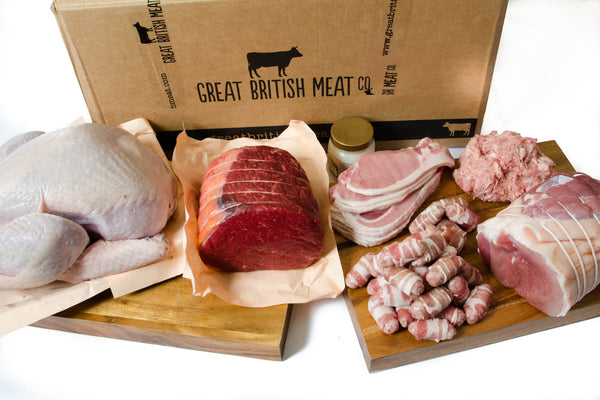
The Christmas season is finally upon us! It’s the season of gift giving and get togethers with friends and love ones. Not only is Christmas the season of festivity and generosity, it’s also the season of meats! One of the best things to give away this season are Christmas meat hampers. Meat hampers will surely be well received and are just classic way of saying Merry Christmas! There are three main things you have to keep in mind to make a great christmas meat hamper:
Variety is important. You do not want to end up giving the same person a huge Christmas meat hamper that only has one type of meat in it. If the person you are giving it to do not particularly like other types of meat, for instance he/she only prefers to eat turkey then fill your Christmas meat hamper with turkey products made into different things. Otherwise, the more varied the Christmas gift hamper is, the better. You are leaving more ways for the recipient to make use of your Christmas gift.
Christmas meat hampers always make a great and safe gift. However, regardless of how common it is for people to give meat hampers, your Christmas meat hamper should also show your thoughtfulness. As mentioned above, you should know what types of meat and style of meat preparation the recipient would enjoy. Some people might enjoy a traditional whole turkey where, whereas a growing trend is to get a boneless turkey joint.
Quality should always come before quantity. It is important that you only include choice and premium meat in your Christmas gift hamper. There is no point in giving a large meat hamper filled with substandard meat products. A smaller meat hamper with only the best produce will be more appreciated and enjoyed, there’s no question to that. Quality British meats although sometimes a little bit more expensive are generally far superior in eating quality than cheaper imported meat that has been flown half way around the world (more common than you think during the Christmas season). You can find great deals at local butchers and online butchers, but remember to be sure that you know where the meat comes from for your Christmas gift hamper.
Lastly and most importantly, you should always consider the practicality of your Christmas gift hamper. Unlike other Christmas gifts, meat hampers are not meant to be kept for long. Remember that meat products are perishable goods and should be consumed right away so the size of your meat hamper should be carefully thought out. Your Christmas gift hamper therefore should be just the right amount so the recipient can consume them all while they are still good. Consider how many people will be eating and what is the storage time of the meat items you are including in your Christmas meat hampers.
]]>
Lamb Shoulder is the perfect joint for slow (and lazy) cooking, making it perfect for weekend cooking. It has just the right amount of fat to naturally baste the joint while cooking, which makes for a lovely rich and juicy meat when it is cooked with exceptional flavour.
Learning how to cook lamb shoulder can seem daunting at first, but it’s really simple when you know how. In this article, you’ll learn an easy-cook method that cooks in a similar low-and-slow style to pulled pork for 4-5 hours on a low heat and can then then pulled apart or sliced with ease.
Lamb is such a versatile meat, and because it can handle bold flavours so exceptionally well, you can adapt this technique and develop your own recipe and style to suit your taste.
So there you have it, an easy cook method of how to slow cook lamb shoulder. You can adapt it and modify however you want, but the basic principle will always apply - lamb shoulder is super easy to cook.
Your presentation doesn’t have to be perfect, it’s arguably not meant to be, but the flavours are without question the star of the show here. We’d love to see how you get on with cooking lamb shoulder, and if you do post an image on social please use the hashtag so we can see it.
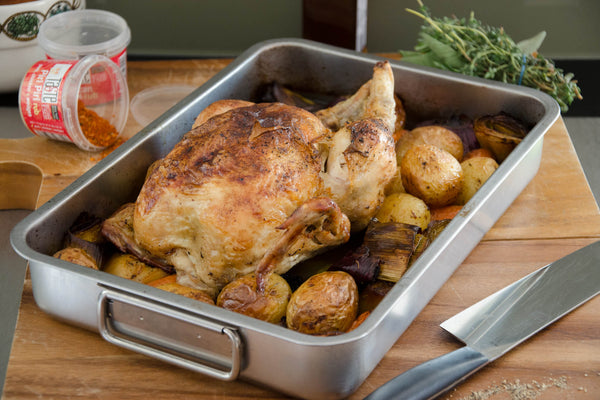
]]>For juicy, melt in the mouth chicken, lots of chefs will turn the bird over during cooking. To an extent it’s an oven version of a chicken rotisserie, (which we all love right?) as it makes sure there is even cooking, as the heat penetrates the bird evenly. This makes sure the meat is nice and moist, and although it takes a bit more care and attention than just whacking it in the oven, it’s definitely worth it, if you like juicy chicken with a lovely crispy skin!

We'd love to see some upside down chickens on social media, and use #MeatSocially for a chance to wina Monthly Meat Hamper!
]]>
Lee Stainthorpe is the head chef at the Vermont Hotel in Newcastle upon Tyne. Having worked under a number of celebrated chefs across the North of England over a 20 year career Lee is well placed to lead the catering team at this flagship city centre hotel. We’re really delighted Lee took time out of his very busy schedule to speak to us.
To an extent it does I guess, but I don’t really think about that. Whether large or small, a kitchen operation is pretty much the same to organise and run. The main difference with a refined hotel offering is that it’s a very diverse operation we have here, and whether that is breakfast, banqueting or fine-dining, planning is always the key to success in the kitchen.
How did you get started cooking?
It sounds a bit strange now, but when I went to school we did a class called home economics, which anyone under 35 probably has no idea what that was. Essentially it was a schools way of teaching basic cooking skills to kids, and it was my first introduction to cooking myself from scratch. From there I went to study a City and Guilds in Catering at college, before getting my first job in the industry.
How has the industry changed over the years?
There seems to be less hunger in a lot of the younger generation of staff at entry level. When I was starting out it was accepted that to get ahead you had to work bloody hard and that the hours would be long. I’ve always been a hard worker, and that is the number one thing I look for in any apprentice or member of the team. I can teach someone how to cook, but having the drive to want to work hard is something that is much harder to instill. This is in no way a 9 to 5 job, but a lot of people either don’t get that, or don’t want that.
What is the best advice you could give to home cooks?
Plan ahead. Something as simple as reading a menu before you start will make a massive difference. If you just dive straight in you’ll almost certainly get it wrong. Planning is at the heart of all good cooking for me.
Some of the busiest restaurants I’ve worked in would have seemed like organised chaos to the untrained eye, but I can assure you they are well oiled machines. I used to work at Heathcoates, (Paul Heathcoates restaurant) in Manchester, and we were turning around 300+ covers every evening at peak times, and the only way you can do that is military style planning across the operation.
What is the best dish on your menu?
We do locally sourced lamb with butternut squash and leek, that is really popular at the moment as given the cold weather, it’s perfect comfort food.
What is your favourite cut of meat?
Lamb shank, but somewhat controversially I like to serve it deep-fried not on the bone. You braise it in the normal way, but then re-roll it, and cover in flour and breadcrumbs before deep frying.
Finally, what do you see in the future for food and menu development?
I think there will be more choice, more diversification and more personalisation. People will become more used to being able to ask for what they want when they want it. As a top end hotel, we always accommodate to our individual guests needs, as it sets us apart from the run of the mill establishments that can’t tailor the menu.
Lee Stainthorpe, is Head Chef at the Vermont Hotel, a landmark hotel in the centre of Newcastle-upon-Tyne.
]]>The master of a table dissects a bone with ease and grace, he is not only well thought of, but admired’ (Rev John Trusler, The Honours of the Table, 1788)

The key to becoming a good meat carver, is to start withgood meat! That sounds pretty obvious, but in the simplest of terms, good meat that comes from good stock, on a great farm, and that has been properly hung by the butcher, will cut and carve much better than young meat, which is generally what you get from the supermarket. Meat needs hanging to tenderise it, to allow the muscles time to relax and for the flavour to mature. When a carcass hangs, the fibres of the meat start to break down. This does involve shrinkage but that is where the meat magic takes place, and improves the flavour and tenderness when eating.
It is for this reason that supermarket meat is rarely (if ever) hung on the bone, as not only is the process time consuming, and time is money to the big multinationals, but it also allows the meat to shrink, which shrinks their profit margins. At a consumer base level, you have got two choices - you either pay more to a butcher and let the meat shrink in his cold (aging) room or fridge, or you pay a supermarket and watch the meat shrink in your oven. It really is that straight forward.

It is worthwhile considering what meat is best for Boxing Day as early as possible. Although people put a lot of time and effort into planning Christmas Day’s menu, Boxing Day is often an after thought, and if you don’t have a plan you’ll find yourself serving the inevitable turkey sandwiches. With a bit of creative planning and the right easy cook joint, it can be a stand-out day in it’s own right. To be fair, as the family Christmas cook I actually enjoy it more than the big day itself, as there is less pressure to perform, and most of the hard work has been done already the day before.
Boxing Day is a time to relax and unwind with family and friends. It might involve a big walk in a country park, or being in your comfy clothes all day watching TV and building toys. Regardless of what you do, everyone will need feeding, but nobody wants to be stuck in the kitchen all day.
One of the best tips I was given from a chef we work with, was to think about Boxing Day as a ‘one-joint day’. “Get yourself a big joint, pop it in the oven for a few hours, and then people can eat it for the rest of the day” It’s so simple and instantly turns christmas leftovers into a buffet table.
The key to this is to go for simple, hearty crowd-pleasing joints. I used to opt for a Gammon Joint, as that is perfect finger food, and can be prepared in advance, but that is now the Christmas Eve showpiece in our house. Last year I went for arguably the ideal joint to cook on a day when relaxing and taking it easy (as the Love Pork advertising campaign goes) with Pulled Pork Shoulder. It still amazes me when guests think there is something complex or mystical to good pulled pork, when really the key is just taking it easy. If you are hosting Boxing Day for the first time, you really can’t go wrong with a Pork Shoulder cooked low and slow. It is so versatile and unfussy, and if we are being honest is great ‘booze-food’. Unless you are entertaining Hycthe Bucket’ it is absolutely acceptable to serve with any leftover veg from Christmas dinner, but you might want to throw in some more roast potatoes as they’re an essential table companion. Working off approx 200-250g per person, a 2kg Pork Shoulder will easily serve approx 10 people which makes it really cost effective.
This year we’ve got guests over again and although I was tempted to go for pork shoulder again, it will be a slightly more formal affair so I’ll be serving a Boneless Pork Loin. Our kids are just starting to realise the delight that is crispy pork crackling, and in my opinion there is no joint to beat the loin for a crackling cracker of a table centrepiece. It’s quick to cook, easy to carve, and all of the usual boxing day elements of going well with leftover veg and spuds apply.
Happy eating, and have a very meaty Christmas.
]]>
Black pudding is enjoying something of a welcome renaissance of late. Having been disgracefully demonised for a number of years, we are finally recognising this iron packed bundle of joy, for the traditional classic taste sensation that it is, and in our opinion, always has been.
This dish is an adaptation of a recipe in Dan Doherty’s wonderful bookwhich any fan of breakfast and brunch will adore. It would make a lovely stocking filler for Christmas, and realistically you’ll get the benefit from such a good tasty recipe book so it’s worth considering. We all tend to have lots of tasty leftover roasties at Christmas, and this would be a lovely lazy breakfast in bed for your other half one day over the holidays.
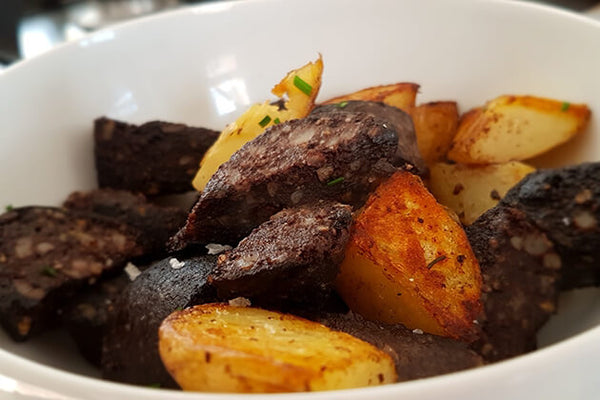
The rich taste of the black pudding works really well in a hash dish, especially alongside some good quality leftover roasties. If you haven’t got any leftover you can just quickly chop some potatoes (either old or new) and whack them in the oven for 45 minutes, before using them in this dish. That said, the really beauty of this dish for us, is that if you are using leftovers it means you’re probably a bit worse for wear, but you’re in luck as this is perfect as a weekend hangover dish, that you can be eating it in under 25 minutes.
Slice the black pudding into 2cm slices and then half again, then cut the potatoes roughly into 2cm cubes so they are a similar size to the black pudding.
Melt the spoonful of butter in a frying pan, and fry the potatoes over a medium to low heat for about 5 minutes until they are nice and brown.
Add the onion to the pan and continue to fry gently for another 5 minutes, before adding the black pudding, and seasoning with salt and pepper. Turn the heat down to low and cook through for 5 minutes stirring and flipping everything as you go.
Towards the end of cooking, stir in the brown sauce, and give everything a good stir for another 2 minutes, then cut in some chives.
Split the hash in two and serve it with some thick cut, buttery toast, or best of all, with a fried egg on top. It won’t make your hangover disappear altogether, but you’ll feel a lot bloody better because of it.
]]>
Chlorinated chicken has been all over the news recently, and is becoming a hot topic in the Brexit debate, with both sides of the argument calling ‘fowl’ (did you see what we did there?). Putting politics aside, would you care if your chicken was chemically treated if it resulted in a 20% price reduction? It looks increasingly likely that consumers will soon have to make a choice of standards over price when buying bleached chicken, so we thought we’d give our butcher’s view on the debate.
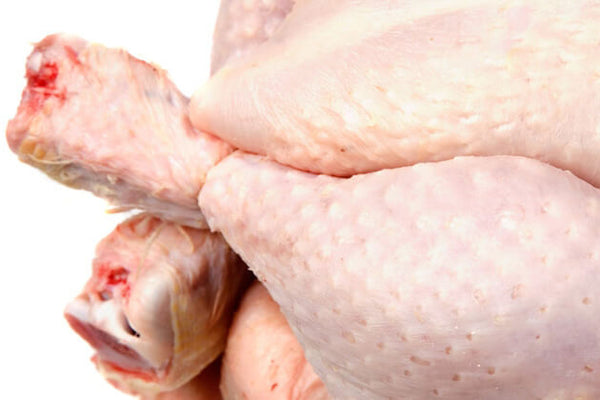
Chlorinated chicken is essentially chicken that has been treated and bleached in the chemical chlorine after slaughter.
Chlorinated chicken is essentially chicken that has been treated and bleached in the chemical chlorine after slaughter. It is a controversial practice that has been banned in the UK since 1997 when the EU banned chlorine-washed chicken over food safety concerns.
It is now back on the food agenda as International trade secretary Liam Fox is in the US urging a rethink as to whether chlorinated chicken, should be made legal to ease the road to a quick post-Brexit trade agreement with the US. The UK don’t currently import chicken from the US despite it being the second largest producer in the world after Brazil, and with chicken retail prices some 20% cheaper than in the UK, it seems inevitable that any trade deal between the US and the UK will include chlorinated chicken.
The argument for the practice is that the solution is used to kill bacteria and it reduces the prevalence of salmonella. The main reason against, is that it encourages poor hygiene across the production process in farms and abattoirs as producers rely on the chemical to rinse the meat of harmful substances at the end of the slaughtering process. It should be added that chlorination is not believed to be harmful for consumption with both the USDA and EU food safety regulator EFSA saying it is safe when the chicken is eaten in moderation.
chicken farming in the UK follows “farm to fork” principles of reducing contamination at all stages of the production chain
In the UK welfare standards are much higher, with the chicken only washed with water and cool air. The approach to chicken farming in the UK follows “farm to fork” principles of reducing contamination at all stages of the production chain. It is not reliant on any one “get out of jail” solution at the end of the process, which is essentially what the chlorination is.
We are not saying chicken production in the UK is perfect (far from it), but it does get the balance of supply and demand right, giving the consumer access to relatively low cost chicken, with some of the highest welfare standards in the world. The simple reason why chicken is 20% cheaper when chlorination takes place after production is that it is cheaper to produce. There is less space, less treatment of disease and generally less animal husbandry. The magic bullet is fired at the end, and many bad things go away. We have been prophesying for a few years now, that chicken was on a race to the bottom, and it would appear the bar is now going to fall even lower.
The noises from politicians about what will happen to food hygiene and welfare standards post-Brexit are very confusing. On one-hand they say we will maintain our high welfare standards, but on the other hand we are looking to do trade deals with countries to encourage cheaper imports with lower welfare standards.
British farmers are the ones likely to suffer the most, they maintain some of the highest welfare standards in the world, but that doesn’t give the cheapest meat. It is a choice of standards over price, and ultimately you will decide what happens as a consumer.
]]>
As a busy working mum, Rachel Taylor’s story will be familiar to every parent with young children. You get home from work, you fly around after the kids, you make their tea, you help with homework, you clean the house, you do the dishes,then it’s bathtime and bedtime, then when the kids are in bed you’re so exhausted you can’t be bothered to cook for yourself, so you reach for the phone and order a takeaway.
It is a situation every one of us with kids here at Meaty HQ can recognise, and if you’re a parent who hasn’t we absolutely salute you (even though we think you’re probably lying). For Rachel however, she realised nights like this, were becoming too frequent, and her weight had spiralled...so she did an amazing thing - she did something about it.
What made you want to go on a transformation programme?
Like a lot of people I was so busy living my life I didn’t really notice how bad things had become. Gaining weight, just like loosing it, doesn’t suddenly happen overnight, it’s a gradual progression, and before you know it, you’re overweight.
For me it was a combination of being busy, having a family and if I’m being honest from comfort eating.My problem was that when I’m feeling down in the dumps, or I’m tired, or both, I comfort eat. Some people reach for the bottle, but for me it’s a bar of chocolate, or a takeaway. It’s bloody exhausting being a parent of a young child with autism, while juggling work and other commitments, and while I’m not making excuses, by the time my son went to bed, most nights I was just so knackered, that sitting on the settee with a takeaway wasn’t even a hard choice to make.
I’d known I was overweight for quite some time, and I’d tried slimming clubs and diets in the past, but never stuck at it. I tried to loose weight for my wedding, but it didn’t happen and I guess that was a big turning point as I don’t like how I looked on my big day, and that made me unhappy. I think the biggest kick for me though, was that my family life had become settled, and we were into a more manageable routine. My son was settled in school, and everything just seemed to be in a better place, so I thought - you know what, it’s time to focus on me now.
How did you go about it?
I’d tried slimming clubs on and off for about ten years or so, and they never worked out because I didn’t like how restrictive they were. If you tell me I can’t have something, it’s going to make me want it more than ever, and with hindsight being on a diet just wasn’t for me, I need a lifestyle eating plan. I knew Slimming World had changed and that it wasn’t restrictive as my friend lost 8 stone following it, so I thought if she can do it, I can do it.
I booked myself into the local club on a Saturday morning, and I went along on my own as I was doing it for me, not for anyone else, and two years later I’m still going and enjoying it more than ever.
It’s nothing like being on a diet, and it’s not complicated it’s just about eating sensibly, having things in moderation, and trading off certain foods for others. If I’m hungry I can eat, and there is no guilt attached as I know I am (usually) sticking within my plan. I even still get to have chocolate, it’s just now I’ll have a small piece instead of a giant bar.
How do you stay motivated?
Social media has been a big help. I joined Instagram around the same time I started to loose weight, and quickly realised the slimming community was very active on the platform, and it’s great to feel part of something. It connects me with people from all over the place and I’ve found support when I’ve been down, over had a blip, and you soon realise there are loads of other people in exactly the same boat as you.
I enjoy finding new recipes and meal inspiration on there, as the whole community loves nothing more than to share a food picture, which drives my other half up the wall at times.
Do you exercise?
I walk a lot, either on my own or usually with the dog, and I have a FitBit which I’m pretty religious at hitting my target step count on, even if that means pacing the house, before I chill on an evening.
What are your top tips for someone looking to do a similar transformation?
What does an average daily meal plan look like?
Breakfast- Overnight oats (40g oats, low-fat yoghurt, quark and frozen berries) nearly everyday except on a Sunday when I like a (healthy) full english breakfast
Lunchis either leftovers from the night before, soup or a salad, but almost always something I’ve made.
Dinneris usually meat and veg, either chicken breast or a sirloin steak.
Snacks- I snack on fruit a lot, with a special liking for Pink Lady Apples.
Drinks- I have 2 litres of water every day, and I know I shouldn’t really, but I also have a can of Diet Coke more often than I probably should when I’m at work, but you have to have some vices.
What is the best thing about the new you?
I don’t feel like I am at the end of my journey yet, I’d like to think I’m at the half-way point. I’m growing in confidence, which is a good thing, and I’m more energetic which is very handy for anyone with kids growing up fast.
My next big aim, is that I want to join a running club. I used to love running when I was younger, but it’s not been something I’ve been able to contemplate for a while, but now it doesn’t seem so far away.
If you have a meaty body transformation story that you’d like to share please drop us a line athello@greatbritishmeat.com
]]>
One of the simple truths of life is that even the fussiest eater loves chicken nuggets. While the industrial mass-produced kind are generally pretty awful, by making your own at home you know exactly what you are feeding your kids.
They are super easy to make, and once you get the hang of making some fresh bread crumbs and using them to coat some fresh diced chicken breast, they really do take just minutes to make. You can dice a chicken breast fillet yourself, but you can buy diced chicken breast already cut, which will save you a job. The nuggets cook quickly inside their crispy coating and can be on the table in less than half an hour.
Our recipe uses some clever seasoning tricks to create a savoury flavour that will appeal to kids and adults. Be careful when adding salt and pepper as you don’t want to overseason them, especially for younger children.
Blitz the bread crumbs in a processor, then add the garlic powder and paprika and give it another whizz. Use the spices in small amounts to season rather than flavour. Add salt and pepper if you want, but again be careful not to add too much, as you can get a healthy salt free meal into the kids here.
Get three bowls, and place the breadcrumbs in one, the flour in another, and the beaten egg in a third.
Using one hand for the egg, and your other hand for the dry ingredients, coat each chicken piece in flour, then egg, then breadcrumbs. We’re not going to lie, it can get a bit messy, but it’s also a great opportunity to involve the kids in the dunking and coating.
Heat an inch of vegetable oil in a frying pan until the chicken sizzles when added. You don't want to overcrowd the pan, but by the same token you want enough pieces so that they don’t burn. Controlling heat in this way is the most effective way of cooking them. You’ll probably have at least two batches depending on the size of your pan.
The nuggets will take about 10 minutes to cook. If the oil is too hot they will over brown too quickly, whereas if it is too cold and they will be soggy. If you are using a thermometer, the ideal temperature for the oil is 190℃.
When the chicken is cooked through, remove the nuggets from the pan and ideally place them onto a wire rack to drain. Cook the next batch of nuggets, making sure to allow the oil to return to temperature before you add them to the pan.
Serve immediately with sides and dipe of your (or your kids) choice.
]]>Hanging meat is really important to the quality of meat, and is the first stage of good butchery. So what is hanging and why is it important for meat?

Hanging is the process of aging or maturing meat by hanging the carcass (or part of it) from a hook. It is usually done in a temperature controlled room, with good air flow. At the butchery we have a walk-in aging room, which is basically a big fridge with a massive fan.
During hanging, the enzymes in the meat make the fibres of the muscles softer and more elastic, which ultimately leads to the meat becoming relaxed and tender. In reality the aging process is also the start of decomposition, but it is absolutely nothing to worry about, as when kept in the right conditions and temperature by the butcher, actual decay that will taint the meat will not happen for weeks, or even months.
Meat also loses moisture as it hangs, which is a good thing when it comes to cooking. Young meat, that is wet and underhung carries too much water in it, which ends up either in your pan or tray during cooking or on your carving board when you cut it. Basically the moisture expands during cooking and leaches out through the stretched fibres of the meat. Oddly this means that ‘wet meat’ actually ends up drier after cooking. Nicely hung-meat is tastier and more tender than unhung meat, it is that simple.
Not all meat hangs the same way, and there are some limits that a butcher needs to observe. Almost all meat will benefit from a few days hanging in a fridge to relax and settle the muscles, and allow the fat to solidify (as it’s pretty much liquid in a live animal). Meats without marbling or good fat covering, do not stand up to lengthy hanging times, as they are not protected from deterioration by the fat. Pork, veal and young lamb fall into this category, but we still give them four to six days hanging to allow flavours to develop safely.
It’s also worth adding that if you intend to freeze meat, you really should get some aged meat. Once again water and moisture are the reason, as the expansion of water in wet meat expands as it freezes meaning ice crystals will tear and push apart the fibres of the meat. Meat that has been properly hung will have less moisture, and will contain more elastic fibres that are better suited to cope with expanding ice crystals. This will mean when you defrost the meat and then cook it, less water will leach out compared to wet meat.
Easily the biggest reason for buying meat from a butcher compared to a big retailer or supermarket, is that the meat is unlikely to be hung properly. Even putting welfare and provenance aside, a supermarket doesn’t hang meat as it leads to weight loss which in turn leads to money (quite literally) going down the drain. A side of beef will looses 15-20% through ‘drip loss’ during the ageing process, and weight is money for the big retailers. There are lots of horror stories of mis-practise where abattoirs are told to hose carcasses regularly to retain moisture and weight.
So there you have it. Hanging meat is the first, and probably the most important stage of good butchery. It is really important to the quality of meat, and is possibly the main reason to buy from a butcher. We hope you’ve learned something new reading this, and it has made you think about where your food comes from.
Drop us a line to hello@greatbritishmeat.com if you’ve got any other questions about how we age or anything else.
]]>
While the black and white spots of the friesian cow may make it pretty enough to be first choice for children’s books and TV ads, there’s a very different looking breed that steals the show when it comes to getting a tasty steak.
Imagine an idyllic countryside scene - rolling hills, a few giant oak trees scattered along hedgerows, and with a gentle gleam of the setting sun there’s highlights of gold across the green landscape. Those flecks of gold in your imaginary scene are likely Limousin beef cattle, which are the real gold when it comes to top quality steaks.
Considered as the best breed for steaks by many people - from top chefs and butchers to the humble meat-lover - Limousin are not the largest or heaviest cattle in the world, but they are prized for other qualities.
The meat from Limousin cattle is extremely popular among chefs and connoisseurs as it is delicate, has a low proportion of bone and fat (when reared appropriately) and is finely marbled. And, thanks to its strong flavour, the demand for Limousin cattle grew rapidly since its introduction to the UK in the early 1970s. By the mid 1980s the Limousin breed had cemented itself as the UK’s most popular beef breed, and there at the top spot, like a stubborn bull, it has stayed.
A typical Limousin cow will weigh around 650 kilos, and bulls can sometimes reach up to 1,000 kilos. The breed’s golden, light to dark red coat distinguishes it from other breeds, and while they are now a very common sight in Britain, the breed actually originates from the southwest of France.
Originally popular in the region as draft animals for agriculture, farmers later utilized the breed as a source of especially flavoursome meat. Reared in the valleys of the low mountain ranges, Limousin cattle mixed with other breeds over the centuries, enabling them to preserve their special qualities.
While the origins of the breed are always up for debate, there is a school of thought that Limousin cattle have been around for longer the civilised man, with the images of cattle in the caves near Lascaux, which date back millennia, showing a striking resemblance to today’s Limousin cattle.
The popularity of this cow as a meat breed is not just confined to France but extends around the world with farming of Limousin in Europe, North America, and Australia. Together with Charolais cattle they are one of the most popular breeds in meat production. This is partly thanks to their flavoursome meat, but also because these animals are a very hardy breed, meaning farmers can keep them out to pasture all year round, making them very popular as grass fed cattle.
And there you have it, a breed that is as popular with the farmers of the world as it is with our stomachs. Hardy and popular enough to last for centuries (or even millennia) to come, the beef of a Limousin is one we could never say no to, and thankfully, won’t have to.
]]>
This is a meal is all about crisp lamb chops, and while you can use a knife and fork, there is something about eating with your fingers that signals spring has sprung, and alfresco dining isn’t too far away. Roasted in the oven with some crushed new potatoes, flavoured with lemon and garlic, this is comfort food with Italian flair.
The peas, along with the bright sunshine lemons, lend a summery shimmer to the dish, but the comfort factor makes it perfect for year round eating. The side dish is our version of an Italian classic; use sweet frozen peas and deli style artichokes tossed together. The peas are hot, while the artichokes are cold and they go together so well. With the crisp lamb and the crunch of the potatoes, they make a memorable yet ridiculously simple meal.
Ingredients
Pre-heat the oven to 190°C
Cook the new potatoes in some salted boiling water for 10-15 minutes. They need to be almost cooked, but still be a touch firm. When cooked through, rinse and allow to cool slightly then crush them with the back of a fork so that they spilt and bash up, but still stay whole. Arrange (or scatter) the potatoes in a decent size baking tray with plenty of room. Mix in the lemon wedges and the garlic cloves. Lay the lamb chops on top of the potatoes and season with salt and pepper then tuck in the rosemary sprigs.
Bake in the oven for about 45 minutes, or until the chops and potatoes have crisped up nicely. You can’t really over-cook them, (especially if eating with your fingers), so don’t worry too much about timing, just have a look and when everything is nice and crispy, take them out. Heat the peas as per packet instructions (probably only 1-2 minutes), tip in the artichokes with their marinade and add the chopped parsley. Stir to combine and serve with the lamb and potato dish.
Nutrition (per serving):
If you learn how to cook chicken drumsticks on the bbq you are part way to being a top bbq host. So many bbq’s we’ve been to don’t know how long to bbq chicken drumsticks for and serve you up burnt to a crisp chicken drummers. It’s a sure fire way to spot a host who isn’t great on the grill. Cooked properly on the bbq, chicken drumsticks are delicious and succulent, with a lovely crisp skin. They lend themselves to any number of spices and sauces, and they are really cost effective and a big hit with old and young alike but more and more of us have stopped getting them for the bbq because of not being sure how to cook them.
The most common mistake is putting the drumsticks on the BBQ when the temperature is too high. If you do this, you’ll burn the skin and probably take them off before they are cooked through, which is a BIG NO NO, unless you are trying to give your guests food poisoning, which hopefully you’re not (if you work in health and safety, or food safety this is a joke btw).
Ingredients
You want to cook the drumsticks on a medium heat, so cook burgers and steaks and things that like high heat first, and ideally you want a temperature around 150℃ if you are using a thermometer or bbq reader.
Add spices, seasoning and sauces either towards the end of cooking for the last 10 minutes or so, or after cooking. If you put the rub/sauce on before cooking, the chances are it will char the sauce not the skin, so you loose the taste.
Put the drumsticks on the BBQ and cook for 30-35 minutes, turning them every 5 minutes using a pair of bbq tongs so they don’t burn. Ideally you want to use a meat thermometer and cook them until the internal temperature is 75℃ in the thickest part of the drummer. If you don’t have a thermometer, insert a skewer into the thickest part and check the juices are running clear.
Take the drumsticks off the BBQ and cover them in your sauce or rub of choice. Let any excess drip off them, and then return them to the bbq and cook over what should now be a low, gentle heat for 10 minutes until they are nice and golden all over.

While cooking everything on the bbq is a lovely idea, the reality of most parties, is that using the oven is sometimes a much better option in terms of getting everything out and serving it at the same time.
A top butchers tip, and a great variation on a chicken drumstick for a bbq party, is to french trim chicken drumsticks, so they become a ‘chicken lollipop’. They are much easier to hold than a standard drummer as there is no sauce or skin around the base of the drum, just the bone, making them much easier to dunk into sauces and dips, and gnaw on.
To make a chicken lollipop you want to trim the skin and fat away from the bone. Using a sharp knife, cut around the drumstick to the bone, just below the main meaty part of the drummer. Be careful not to cut into the bone, and scrape away the skin and cartridge, to leave you with a clean bone end.
Although usually seen on cuts of lamb (legs, racks and shanks), it is not too common on chicken drumsticks, but it’s super easy, and looks much nicer than a regular drumstick, so you’ll earn host bragging rights even before you serve them, and if you cook them to perfection using this cooking-guide), you’re onto a bbq winner.
]]>